Building the Wedding-Day Timeline Around Light
Sunset is the only fixed appointment on your wedding day. Here is how we build an hour-by-hour timeline backward from it so the light works for you instead of against you.

Almost every wedding timeline we are handed starts at the top of the day and adds forward. Hair and makeup at nine, dress at two, first look at three, ceremony at five. It reads logically and it fails constantly, because the one element nobody negotiated with is the sun. Light does not care that cocktail hour ran long. It leaves when it leaves.
So we build in the other direction. Sunset is the only truly fixed appointment on a wedding day, and after 15 years and more than 1,000 weddings we plan every other hour in relation to it. That single change (working backward instead of forward) is the difference between portraits made in flat overhead glare and portraits made in the fifteen minutes that photograph like nothing else all year.
Find Sunset First, Then Place the Ceremony
Before we discuss anything else, we look up the sunset time for your exact date and set the ceremony against it. In Los Angeles, a June sunset lands near 8:10pm and an early-November sunset lands closer to 4:55pm. Same venue, same guest count, completely different day. A 5:00pm ceremony in June is a gift. A 5:00pm ceremony in November means you are exchanging vows in the dark.
For an outdoor ceremony, the target we push for is a start time roughly two hours before sunset. That puts the sun low enough that faces are not carved by hard shadow, but leaves real daylight in the bank for portraits after the recessional. Ninety minutes before sunset is the aggressive version and it works when the ceremony is short. Thirty minutes before sunset sounds romantic and almost always means we are chasing the last light instead of using it.
Indoors, the calculation changes but does not disappear. A ballroom or a cathedral has its own light, and what matters is when the windows go dark and how much control we still have. Our Vibiana wedding guide walks through that logic in one specific downtown building, and the same thinking transfers to almost any historic venue with tall glass.
Protect the Golden Hour Like a Vendor Appointment
The thirty to forty minutes before sunset is the most valuable photographic window of your entire day, and it is the one couples give away most easily. It disappears into a receiving line, a long cocktail hour conversation, a toast that got moved.
So we put it on the timeline as a named block. Fifteen minutes, sometimes twenty, pulled out of the reception, and we tell the planner and the coordinator about it weeks in advance so nobody schedules over it. Guests barely notice. You come back to a party that is already warm.
What you get for those fifteen minutes is light with direction and color that no equipment reproduces convincingly. Low sun rakes across a face, separates you from the background, and turns hillsides in Malibu or the ocean off Palos Verdes into a real backdrop instead of a bright gray smear. If your venue faces west, we plan for backlight and haze. If it faces east, we plan for the warm glow bouncing off the building behind us. Either way it is a decision made in advance, not a scramble.
The Morning Matters More Than People Think
Getting-ready coverage is where light quality is most often squandered, because rooms are chosen for square footage rather than windows. A suite with one large north-facing window and a lamp we can switch off produces better preparation images than a chandeliered hotel salon with mixed color temperature bouncing off gold wallpaper.
When we scout, we ask for the room with the biggest window and we ask permission to move a chair. That is usually the whole intervention. We stage the dress, the shoes, and the invitation suite in that window light, and we place you there for the final touches. It costs nothing and it changes the first ten pages of your album.
We also ask that the room be reasonably clear at the moment of the dress. Twelve people and a room service cart in the frame is a lighting problem as much as a composition one, because bodies block the only good light in the room.
A Light-First Timeline, Roughly
Every wedding is different, but here is the skeleton we start from for an outdoor Southern California ceremony, expressed as offsets from sunset rather than clock times.
Hours counted backward from sunset
- Sunset minus 6 hours: coverage begins, details and getting ready in window light
- Sunset minus 4 hours: dress, then first look if you are doing one
- Sunset minus 3.5 hours: couple portraits in open shade, unhurried, no guests waiting
- Sunset minus 3 hours: wedding party and immediate family, staged in shade near the ceremony site
- Sunset minus 2 hours: ceremony begins, sun low enough for even faces
- Sunset minus 1.5 hours: recessional, then remaining formal family groupings
- Sunset minus 1 hour: reception entrance, first dance, toasts while daylight still fills the room
- Sunset minus 30 minutes: the protected golden hour block, fifteen to twenty minutes, just the two of you
- After dark: night portraits, dancing, and the exit
What a First Look Buys You
A first look is not a style question so much as a timeline question. Choosing one moves your couple portraits and most of the group work into the afternoon, which means the hour after your ceremony belongs to your guests instead of to a photo list. Skipping it concentrates everything into the window between recessional and sunset, which is workable when the ceremony is short and the family list is disciplined, and painful when it is not. We laid out both cases honestly in first look or aisle reveal.
Either choice works. What does not work is skipping the first look, scheduling a 4:30pm November ceremony, and expecting thirty formal family combinations plus a full wedding party set plus sunset portraits to fit into forty minutes of remaining daylight. That is arithmetic, not photography. Building the family list in advance, the way we describe in our formal wedding photos shot list, is what makes the compressed version survivable.
Sunset is the only vendor on your wedding day who will not wait fifteen minutes for you.
After Dark, and Who Builds This With You
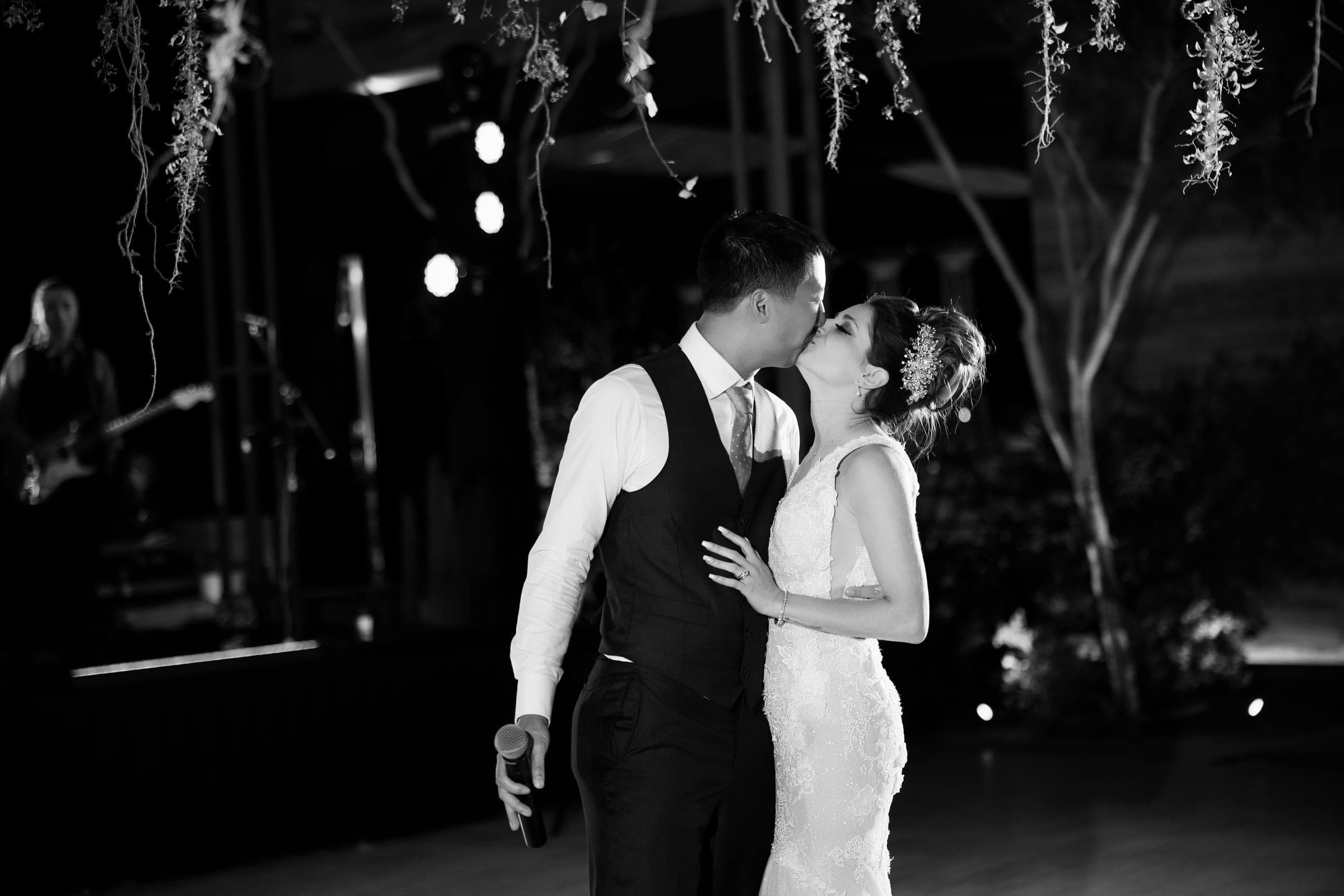
When the sun is gone we stop borrowing light and start making it. Night portraits are their own reward: a lit frame against the facade of a downtown building, a silhouette under string lights at a ranch, the two of you separated cleanly from a dark background. Those images look nothing like the afternoon work, which is exactly why we want both in the album.
Reception lighting is a related conversation we have with your planner. Uplighting color affects skin tone, and a dance floor lit entirely in deep blue or magenta changes what we can deliver. We bring our own light for the key moments so first dance and toasts hold their color regardless.
We build this timeline with you, usually a few weeks out, alongside your planner and coordinator, and we share it so everyone is working from the same document. It is one of the least glamorous parts of our wedding coverage and one of the most consequential. When photo and film are handled under one roof, as they are with our films team, the two crews plan around the same light instead of competing for it.
If you are still choosing a venue, orientation is worth weighing early. Our guide to the best wedding venues in Los Angeles notes which sites face the ocean, which sit in canyon shade by late afternoon, and which have indoor backup that photographs well. Tell us your date and we will tell you what the light will be doing. Start that conversation on our contact page.